Showing posts with label Batman. Show all posts

Thursday, January 26, 2012

I'm reading comics again! // Reviews: Daredevil, Batman, Wonder Woman

Operation Catch-up on Comics has officially begun, since I FINALLY finished reading A Clash of Kings yesterday. This morning on the way to work, I read three comics.

Daredevil #8
Written by Mark Waid; art by Kano; colours by Javier Rodriguez; Marvel

This is part 2 of a two-part crossover with Amazing Spider-Man. Waid wrote the ASM issues as well, so the two really flow together as one two-part story, despite the different art team on the books. I've been enjoying Daredevil since this volume began, due as much to Waid's dialogue as to the great art by his collaborators. Here, the art by Kano is nowhere near the level of either Paolo Rivera or Marcus Martin, but Javier Rodriguez's colours help give it a similar feel.

I was pretty turned off by a few awful examples of stupid-looking sexualized poses for Black Cat, though. That's the kind of shit that takes me right out of a story, unfortunately. To be honest, I'm not a huge fan of the way the character is written either. (SPOILERS:) She's being very flirty with Daredevil throughout this issue, and at the end you find out that she was paid to seduce him in order to steal something from him. Hmm. A female character in a comic book having to resort to her sexuality in order to achieve something. Where have I seen that before? (Um, maybe in a million other sexist comics out there?)

It's kind of sad, really, because up to this point there wasn't really anything I didn't like about this series. Even the fact that this was a crossover didn't bother me, in part because I happen to be reading both series, but also because it's a crossover that makes sense. I love the way the two characters interact and Mark Waid's Spider-Man is even funnier than Dan Slott's. (Not to knock Dan Slott's writing. I'm enjoying ASM a lot, in spite of the mostly terrible art.)

So, yeah, that was kind of a bummer, but I enjoyed the story otherwise.

Batman #5
Written by Scott Snyder; pencils by Greg Capullo; inks by Jonathan Glapion; colours by FCO; DC

I loved Scott Snyder's run on Detective Comics just before the relaunch, but so far his run on Batman hasn't grabbed me to the same level. Is it because of the art? Maybe. Greg Capullo is a fine artist, but he's no Francesco Fancavilla. But mostly I think it's the story. And maybe also the fact that I'm kind of over Bruce Wayne as a character.

This issue's doing the whole Batman being drugged up and people screwing with his mind thing. It's not the first time we've seen something like this. It ends with a moment that might have been kinda shocking if it weren't on the freaking cover. There's also a neat trick with the layouts changing direction halfway through the book, forcing you to physically turn the book upside down as Batman spirals deeper into the labyrinth. It's kinda neat.

I'm not hating this. It's a solid Batman comic. I just think I'm at a point where "solid Batman comic" doesn't really cut it anymore. Or maybe it's just a phase. Or maybe the story's about to get really good and blow my mind. We'll see.

Wonder Woman #5
Written by Brian Azzarello; art by Tony Akins; colours by Matthew Wilson; DC

This was definitely the most underwhelming issue of Wonder Woman since the relaunch. And I don't think it's just because Cliff Chiang didn't draw it, though that certainly has a huge impact. Tony Akins' art is actually quite nice, but Cliff Chiang's been absolutely killing it for the past four issues, so it's a tough sell. I'm also getting really tired of Brian Azzarello's dialogue, I think. I don't know, it just sounds too scripted or something, like it's simultaneously trying too hard and not hard enough. It's hard to put my finger on it, but it's bugging me.

On the other hand, I kinda like the way this book is turning into a soap opera involving Greek gods. I have no idea why they described this as a horror book. It's totally a soap.

Saturday, September 3, 2011

Review: Justice League #1

Justice League #1
Written by Geoff Johns; pencils by Jim Lee; inks by Scott Williams; DC.

(Spoilers here.)

When you've been told repeatedly for several months that the issue you hold in your hand is "historic," that it sets the tone for the relaunch of an entire line of comic books, and the creative team behind it includes two of the three people who conceived of and orchestrated the whole relaunch, yeah, it sets up a certain set of expectations.

Add to that the normal expectations that you have for any first issue of a new series. And the expectations you have for a comic book that features Superman, Aquaman, Wonder Woman, Green Lantern, Batman, Flash and Cyborg on its cover.

Don't get me wrong, it's not that I expected it to be awesome. In fact, I wasn't even sure I was going to buy it. The guy at my local comic shop was like, "Come on, you're not even gonna try it?" So I picked it up just to show that I had an open mind about this whole relaunch business. I'm also not a huge fan of either Geoff Johns or Jim Lee, though I think both have done some good work in the past. So, no, I didn't think it was going to blow my mind.

What I did expect, though, was... I don't know, some kind of hook? Something, anything, that would make me want to read the next issue? A hint of how awesome it is to have the "big seven" (well, big six, really, since Martian Manhunter has been replaced by Cyborg) reunited as the core members of the Justice League?

There is none of that in this book. What we get are Batman and Green Lantern being arrogant macho assholes full of themselves. And then on the last page, Superman shows up and hints that he's as much of an arrogant macho asshole full of himself as they are.

Basically, the theme of this book is MY COCK IS BIGGER THAN YOURS.

And that's pretty much it. There's no story. Batman meets Green Lantern. Cops in Gotham are shooting at them and the two superheroes are boasting that they can handle it and don't need help. Then they find a box and Green Lantern's ring is unable to identify it, which he says is impossible, but just by looking at it Batman is able to deduce that it's some kind of alien computer. From this, they deduce that this guy in Metropolis they've heard about might know something about it, so Green Lantern flies them there, and then Superman comes out and is like, "So, what can you do?" Then he pulls out his cock and Batman and Green Lantern's jaws drop.

Okay, I lied about that last part. What you actually get is a teaser that says, "Next: Batman vs. Superman." Because apparently this is what new readers are going to be interested in, a bunch of testosterone-filled frat boys fighting amongst themselves for the alpha dog title.

Yeah, it sucks. It's worse than anything I could have imagined. It's a steaming pile of burning caca. And if this is meant to set the tone for the New 52, things are about as grim and hopeless as I feared they might be when I started seeing some of those awful costumes redesigns several months ago.

The good news, for me anyway, is that I don't think that's true. I don't think the tone or quality of this book really has anything to do with what we can expect from the books that I am looking forward to. So I'm not going to give up on the New 52 because the flagship title sucks. Swamp Thing, Animal Man, Batwoman and the few other titles I'm looking forward to will succeed or fail on their own merit.

But what's depressing is that DC had so much riding on this book. I don't know whether non-regular readers of comics came into the shops last Wednesday to check it out like DC was hoping they would. But if so, are they really going to get sucked in by this? Are they going to come back to buy Action Comics #1 next week, or Justice League #2 next month? I find that incredibly hard to believe.

What would have made a better first issue? Start with a bang! Start with the Justice League already assembled and show us how awesome it is to have all these classic, iconic heroes kicking ass together. Show us how much FUN a comic like that can be. There's no fun in this comic. Just a bunch of angry dudes banging on their chests and asserting their dominance.

It's garbage.

Friday, May 20, 2011

One-paragraph reviews: Gates of Gotham, Teen Titans, Booster Gold, Silver Surfer

(No spoilers unless otherwise indicated.)

Batman: Gates of Gotham #1 (of 5)
Written by Scott Snyder and Kyle Higgins; art by Trevor McCarthy; DC

My expectations for this mini-series were insanely high. Partly because Scott Snyder's recent work on Detective Comics resulted in one of the best Batman stories I've ever read and I was looking forward to more of the same. And partly because Cassandra Cain, former Batgirl, is set to play an important role in it. Cass has a very passionate fanbase and she's a character I've read a lot about but haven't had much first-hand exposure to. While this first issue doesn't quite live up to the hype I built up for it, it's still pretty good. I'm not the biggest fan of the art style. It has a cartoony feel that doesn't appeal to me and I really dislike the character designs for all the bat characters when they're out of costume. But these are mostly due to aesthetic preferences, not a lack of skill on the artist's part. The important thing is it's good storytelling. Kyle Higgins' dialogues don't pack the same kind punch that Synder delivers with surgical precision in Detective, but it does the job. Cass only makes a brief appearance in the end, but it looks like she's going to play an integral part in the story going forward. We only get hints of what is really going on in this first issue, but it sets up an interesting mystery. Looking forward to the next issue.

GOOD

---

Booster Gold #44
Written by Dan Jurgens; art by Dan Jurgens and Norm Rapmund; DC

(SPOILERS)

This is the first issue of Booster Gold that I've ever read, although I've previously enjoyed him as one of the main characters in 52. I was thankful for the in-story recap, which make this a very easy jump-on point for readers like me who are mostly picking this up because it ties into Flashpoint. This issue is mostly set-up, as Booster finds himself stranded in the Flashpoint timeline and realizes that something is very wrong. Booster and Barry Allen (who's not in this) seem to be the only two people so far who remember the old timeline. Jurgens' dialogues have a very old-school feel, which I don't mind at all. Considering how exasperating the ongoing Doomsday crossover in the Super titles has been, I wasn't too thrilled to find that he's going to be an antagonist in this series as well, albeit as a transformed, Flashpointified version of the character. I guess Jurgens did create him, so it shouldn't be too surprising. In any case, I'll keep reading, as I want to know how Booster pulls through this mess and what part he's going to play in restoring the timeline.

OKAY

---

Silver Surfer #4 (of 5)
Written  by Greg Pak; art by Harvey Talibao, Iban Coello and Sandu Florea; Marvel

I don't have a lot to say about this issue. I think the art continues to be pretty weak, while the story continues to be pretty good. This concludes next month. Maybe I'll have more to say then.

OKAY

---

Teen Titans #95
Written by JT Krul; art by Nicola Scott and Doug Hazlewood; DC

Nicola Scott is one hell of an artist. I suspect this title is going to end with #100 in August, but you can be sure that I'll follow Nicola to whatever book she'll be drawing next. In the meantime, she and inker Doug Hazlewood are drawing the shit out these characters and the story could be the most inane, boring crap and you would hardly notice. Thankfully, though, this story is actually pretty good. The combination of decent story and stellar art makes this one of the best books DC currently puts out, which is remarkable when you consider that before this creative team took over it had long been considered awful by fans. (I wasn't reading it, so I can't confirm that.) The one thing that has me feeling a little uncomfortable is the way this story turns Hindu mythology into supervillany. Obviously, a lot of comic book stories and characters are inspired by myth or religion, but int he case of Greek or Norse mythology, these are religions that are largely "extinct" (although some people still believe in them) and in the case of Christianity, it's usually the writer's own culture that is being mined for inspiration. Here, JT Krul steps dangerously close to cultural appropriation and exoticism. Solstice, the Indian girl who will apparently join the Teen Titans, brings some much needed diversity to the team, but did her first adventure have to be one against comic book versions of her culture's religion? From what I understand, Rankor, the god/demon/villain in this story, is a made-up character not based on any actual Hindu deity, so I don't want to overplay this. It's not that I disapprove of this story or anything. All I'm saying is that these questions remain in the back of my head while I'm reading (and enjoying) this.

GOOD

Sunday, April 3, 2011

"Why so serious?" -- by pre-teen kids!


A friend of mine put together this totally bizarre collection of found YouTube videos of young kids doing the "Why so serious?" Joker scene from The Dark Knight.

It's on a loop, too, so you can watch it ad infinitum!

Tuesday, February 22, 2011

Tim Drake from the Beginning - Part 4: "Rite of Passage"

Detective Comics #618
Detective Comics #618-621 "Rite of Passage"
Written by Alan Grant; art by Norm Breyfogle, Dick Giordano and Steve Mitchell; DC

(Tons of spoilers follow.)

Last time we looked at "A Lonely Place of Dying," the story about how Tim Drake figured out Batman's identity and convinced him that he needed a new Robin. Bruce Wayne agreed to start training him, but without making any promises.

Part of the appeal of Tim Drake as he was established in that story was that he came from a different background than either of the previous Robins. He's not a child in distress that Batman saves and takes under his wing. In fact, he's the one who goes after Batman and convinces him that he needs Tim's help, which is almost a complete reversal of Dick and Jason's origins, where Batman was the one who actively initiated the relationship.

At the core of this difference is the fact that, unlike Dick and Jason and Bruce himself, Tim is not an orphan. Although his parents are busy and frequently absent, they are alive and able to provide for him. If the whole idea behind the character of Robin (at least initially) is that younger readers can see themselves in him, then this all made perfect sense. Most teenagers who read Batman comics are not orphans and probably don't want their parents to die. Tim is a normal teenager who comes from a relatively well adjusted family, so here's someone they can all relate to and through whom they can fantasize about being Robin. (For the sake of argument, I'm ignoring the fact that pretty much every reader of Batman comics actually fantasizes about being Batman. Just go with it.)

So Tim was a fresh and new and exciting take on Robin. It's absolutely baffling, then, that the first thing DC decided to to do with the character after his introduction was to strip him of everything that set him apart from his predecessors. In a story called "Rite of Passage," they swiftly killed his mother and turned him into an orphaned child in distress.

Let's think about that title for a second and what it means. A "rite of passage" marks the transition or progression from one stage to another. In this case, the passage is from ordinary boy to hero. The ritual event that he has to go through in order to make that transition is personal tragedy, or more specifically, the loss of a parent.

Rites of passage usually have a universal quality, so the implication is that this is something Tim has to go through in order to become a hero. Tim himself says so at the end of part 2 (issue #619):


Alfred is quick to dismiss the idea, but everything about this story confirms that this is actually the case. Why else would the editors and writers of this story decide to off his mother in a story called "Rite of Passage" before he gets to call himself a hero?

That decision has never made any sense to me. Tim's origin story provided all the motivation he needed to follow in the footsteps of Dick and Jason. His admiration and respect for Batman, a sense of duty and personal responsibility, courage, etc. Are these not enough to make him a hero? Apparently not. Because Batman is tormented and driven to action by personal loss and a desire for revenge, everyone he works with has to go through the same thing.

It's kind of infuriating. In case you couldn't tell, I don't like this story very much, and it's hard for me to look at it objectively and ignore my fan rage. I haven't even gotten into the meat of the story yet and I already feel like I've said everything that really needs to be said about it. There are a few more things going on that I'd like to point out, though.


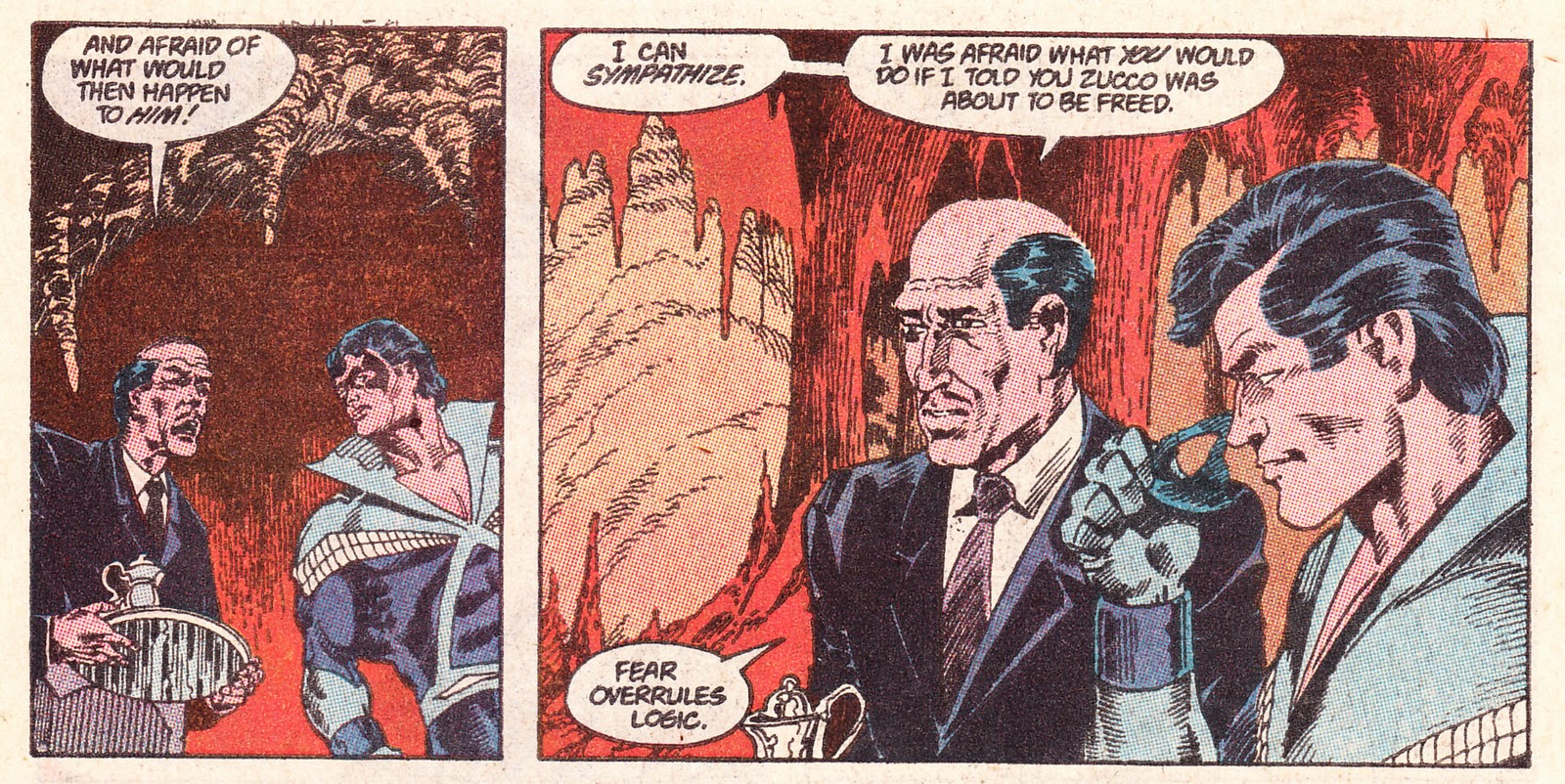
The story opens with a nice tribute to Jason Todd. Tim looks up at Jason's uniform and says, "One day, I'll be as good as Jason. One day, I'll wear the suit. One day, I'll be a hero." It's nice that everyone in the comic has so much respect for Jason, considering how he was killed for the amusement of fans who called a 1-900 number. I'm used to the idea (from some fans) that Jason was out of control and had it coming, so it's nice to see that this is now how he is remembered at this point.

It's also cool that we have stories like this set at a time when Tim is in transition. He's not yet Robin - he hasn't started wearing the costume or going out on patrol - but he hangs out in the Bat Cave and helps Batman in his investigation (mostly making use of his computer skills), and even goes out to confront Anarky while Batman is away. I like that he wasn't just thrown into the role, that he's being eased into it gradually. This is a process that we don't see very often in comics.

Finally, it's interesting to look at this story from Batman's perspective and consider what it means to him. He's obviously still feeling guilty for the way things turned out with Dick and Jason, and he feels a strong sense of responsibility for Tim's well-being. He takes what's happening to his parents to heart and he does everything he can to save them. We see just how personal this is to him at the end when he fails to save them. He's overcome with emotion (horror, then rage, then despair) and there's a huge caption in block letters: "I'VE FAILED!"


Obviously, Bruce knows what it's like to be an orphan and the last thing he wants is for Tim to go through the same thing. And yet, during most of the story, he's unable to show his emotion or get too close to him. He's emotionally distant and he's keeping secrets from Tim. In one scene, he brings Tim his breakfast in the morning, and Tim notices that he doesn't take off the cowl: "He kept the cowl on. As if... he didn't want me to see his real feelings," Tim says in a caption.


It's only at the end, after Tim's mother has died and his father is in a coma, that Bruce really tries to comfort Tim. But when he does, Tim has a vision of the Bat and the darkness it represents. It's a fairly horrifying scene and a little over the top. Tim is snapped back into reality when a nurse invites him to go see his father. Bruce offers to accompany him, but Tim wants to do this alone. The issue ends with Bruce wondering about the burden he's placing on Tim's shoulders: "How do you make up for what he's lost? How do you pay back the pain, and the fear, and the lonely years? Draw power from death? Become like me? The night-monster. The man who taints the lives of all around him. Is that what I want for him? Is that what he'll want for himself?"

It's pretty heavy stuff. A little too heavy for my tastes, to be honest, and I think unnecessary. This is probably the low point of Tim Drake's early stories, but thankfully it gets better.

One last note: I think some of Norm Breyfogle's layouts are really awesome. The focus of these pieces are really on character, and as a result I don't spend much time talking about the art, but I've been really interested in layouts lately, so I may come back to these at a later date.

Next time, we look at "A Hero Reborn," from Batman #455-457. These issues were also collected in a (now out of print) trade paperback, along with the first Robin mini-series.

Wednesday, February 16, 2011

Irrelevant Thoughts

I've been receiving some hate mail from someone who turned out to be a somewhat well known troll who goes around message boards and gets angry at people he disagrees with. The funny thing is that he doesn't join the boards or engage in discussion on them. Instead, he copies the comments that angered him and sends them to the poster by e-mail, adding a few petty and juvenile remarks at the bottom.
What triggered this reaction from him in my case were some comments I posted on Gail Simone's message board:

Fans keep asking why [Cassandra Cain] isn't part of the Bat family anymore, and what this brief appearance [in Red Robin] established was that she exists somewhere out there but for now isn't interested in coming back. In other words, an in-story excuse for justifying not putting her in the books. Before that, it just seemed like every editor and writer at DC had forgotten she existed, but now they can point to that scene and say, no, no, she's not here because she doesn't want to be here. But the end result is the same. She's not in the books.
To this, dude responded that I was mixing up the word "fans" with "trolls." When I didn't immediately respond to his e-mail, he sent a second one, again quoting the above comment and adding, this time, that I was mixing up the word "fans" with "whiny fan boys." And then a few hours later, he sent me the same message again.

I won't mention him by name here, but if you're curious, here are a couple of examples of him doing the same thing to other people. I blocked him. End of story, I hope.

+

I just read Wolverine and Jubilee #2 and Phil Noto's art makes me swoon. It's so beautiful. I just want to look at it forever and lose myself in his panels. I was always a fan of his covers, but this mini-series is the first I've seen of his interior art and I want more.

This isn't quite a review. More like a gushing moment of pure admiration.

+

I have a lot of books I want to review over the coming weeks in addition to my usual coverage of monthly super-hero floppies. So many, in fact, that I'm feeling a little overwhelmed right now. And tonight I should be working on that Tim Drake post, but instead I'm just going to sit back read some comics. 'Cause I'm tired, and I spent all day subtitling some Family Guy episodes. (Which is more intellectually exhausting than you can imagine.)

+

Here's a drawing that I like:


It's Batman wearing legwarmers. Gail Simone said on Twitter than she wanted to see this and Mike Donohue obliged. These are the kinds of drawing I would make all the time if I could draw.

Wednesday, January 26, 2011

Gail Simone on the casting of Tom Hardy as Bane in the next Batman movie

By now, everyone should have heard the news that Tom Hardy has been cast to play Bane, the villain in Christopher Nolan's sequel to The Dark Knight. People who aren't currently reading comics probably know Bane mostly as the villain in the Knightfall story in Batman comics, where he famously broke Batman's back. But these days his most role is as one of the members of the Secret Six, under Gail Simone's pen. Understandably, therefore, a lot of people have been asking her for her opinion on the news. Here's what she had to say in a recent post on her message board:

First, I'm pretty much pop culture ignorant. I don't know much about the actor in question.

And second, I'm conflicted. Here's why.

I don't know Tom Hardy, I don't know much about him. I'm told he was in Inception and Star Trek, but I don't recognize him or remember him in those films. What I DID see him in, is Branson.

And he was FANTASTIC in that. He had many qualities that would fit Bane perfectly. The calm intelligence, the ferocious rage and calculated violence, and of course, his amazing body, all those would make him perfect for being cast as Bane. Honestly, I think for those reasons, he would likely do a spectacular job as the character, particularly in light of some upcoming developments coming up in the book. I think he may be an inspired choice for those reasons, and his bravery as an actor could be the fuel that makes it happen.

However, Bane is a Latino in the comics. More than that, his origin is VERY SPECIFICALLY about a very poor, very brutal South American prison, and being born into that rotten place. I never think of him as a white guy.

Bane isn't the kind of person to think much about his national heritage. It wouldn't mean anything to him. He doesn't talk about it. He doesn't have any interest in it. There's nothing particularly Latin about him, except his origin and the mask, perhaps.

But I think there IS a (probably unintentional) power to him being Latin, particularly coming from poverty. The fact that this man is so much the OPPOSITE of privileged, wealthy Bruce Wayne, son of successful, loving parents, and that he comes from a brutal dirt third-world prison, I think that is always in the back of the heads of the readers, and I think it's powerful. In a big way, Bane is the underdog, in a way unlike any of the other bat-villains. I think that message, that socio-economic revolution is out there, is part of what makes Bane different, and even a little bit threatening to the status quo.

I don't think you get that same friction if Bane is an educated English guy. Where's that class tension? It evaporates.

There are other issues, of course...as we've seen time and again, there's a tendency to whitewash characters of color when taking them from other media to film, and a real history of de-ethnicizing characters in comics themselves. I say again, I don't think being Latin means anything in particular to BANE, but it does mean something a little bit powerful to his CHARACTER.

So, I'm conflicted. I think Hardy is a tremendous actor, and may bring a grace and terror to the character that really makes him sing. In that way, he may be the best possible choice. But I do think Bane is South American, and should be portrayed that way.

I'm not much help on this one, I guess.
What follows is an 18-page discussion, with a lot of people missing the point and derailing the thread into annoying nitpicking and jumping to ridiculous conclusions. I don't particularly recommend reading through the whole thing, but feel free to do so.

As for my own take on the issue, I'm just going to repeat what I said on page 18 (which isn't so much a response to Gail Simone as a response to the discussion that followed):
To me, casting actors that have the same (or at least similar) ethnic background as the characters they play is simply a matter of respect and credibility. I don't buy the argument that there is a "best actor for the role" and if they happen to be of a different race, then they should get the role anyway. Who's the "best actor" is so subjective it becomes meaningless.

I think there are two separate issues that people in this thread are confusing, or trying to treat as a single issue, which hurts the discussion.

The first issue has to do with the link between the actor and the character, and whether they are (or should be) of the same race. This can be applied to every role in every movie ever made.

The second issue only concerns movies that are adapted from some other source material (whether a comic book, a novel, or a previous film). It concerns the link between the character in the source material and the character in the film adaptation, and whether they are (or should be) of the same race.

These are two completely separate issues.

If we take the case of Tom Hardy playing Bane, then, and we take for granted that (a) the character of Bane in the comics is Latino, and (b) Tom Hardy is not Latino, then there are two different ways this could play out:

1. The makers of the next Batman movie have decided to change the ethnicity of the character of Bane. The character is Latino in the comics, but the character in the film won't be. This is a case of whitewashing the character. It doesn't really have anything to do with the casting - it's a writing decision - but it's of course reflected in the casting choice.

2. The makers of the next Batman movie have decided to keep the character's ethnicity as Latino, but they decided to cast a white actor to play the role. This is a case of... mmm, I don't know exactly what to call it. But clearly, it's not the same thing as the above case.

For now, we don't know which of these two scenarios is the correct one. But if we're going to comment on the decision to cast Tom Hardy as Bane, we have to keep these two possibilities in mind and recognize that they are different. Otherwise, the discussion gets incredibly muddled and confusing.

Personally, I feel that both of these possibilities are rather unfortunate. I would have preferred for them to keep the character Latino and to cast a Latino actor to play him. But that didn't happen and it's disappointing. I'm not calling for a boycott. I'm not saying Nolan is a racist. I'm not saying the movie will suck. And I'm not even saying Tom Hardy won't play a great and compelling Bane. I'm just disappointed, that's all. I think people have a right to be disappointed.

I'm going to say that I will be more disappointed if it turns out to be #1 than if it turns out to be #2. Because I think the character loses something special if you take away his ethnic background. And because, as many people have pointed out, a lot of people from Latin American countries do have pale skin, blond hair and blue eyes, I think they can more or less get away with it as a realistic portrayal of the character. That doesn't make it the ideal casting choice, in my mind, (and it doesn't mean that this isn't part of a larger trend or "problem") but it's probably one that I can live with.

Sunday, January 23, 2011

Tim Drake from the Beginning - Part 3: "A Lonely Place of Dying"

Well, here it is, at long last, the insanely delayed third part of my ongoing Tim Drake from the Beginning series. This time, I'm looking at "A Lonely Place of Dying," a story that runs through issues of Batman and The New Titans and features Tim Drake's first appearance as a teenager (following his brief cameo as a little boy in "Year Three") and ends with him putting on the Robin costume for the first time.

If you haven't read them already, you can check out the intro, part 1 and part 2 of this series.

BATMAN #440-442 (1989)
Written by Marv Wolfman and George Perez; art by Jim Aparo and Mike DeCarlo.

THE NEW TITANS #60-61 (1989)
Written by Marv Wolfman and George Perez, art by George Perez, Tom Grummett and Bob McLeod.

(This review contains major spoilers for a story published over 20 years ago, so you should probably read it anyway.)

I'm going to start with a detailed synopsis before doing a more in-depth analysis of what struck me as the most interesting aspects of the story. You can skip ahead if you've already read the comics and don't need a refresher.

Synopsis

"A Lonely Place of Dying" picks up where "Year Three" left off, with Batman becoming increasingly violent and careless in the aftermath of Jason Todd's death. Chapter 1 opens with Batman fighting Ravager, while an unseen photographer takes snapshots from a distance. The photographer is Tim Drake, though he remains hidden for now. He knows that Batman is Bruce Wayne and next he goes looking for Dick Grayson, first at Titans Tower, then at Starfire's place, and finally breaking into his apartment, where he finds a newspaper article about Haly Circus's imminent closure.

Meanwhile, Alfred is getting tired of playing nurse. He scolds Bruce for acting recklessly, reminding him of something he once told Dick when he was first training him in combat: "We're not brutalizers. We've got to think with our heads, not with our fists." Bruce doesn't even bother answering him. He changes into his Batman costume (while simultaneously shaving) and goes out on patrol.


Still, Alfred's words do sink in when he finds himself ambushed and realizes he hasn't been doing very good detective work lately.


"What were you thinking with?" says the caption. Batman looks at his fists. "And Batman knows the sad, ludicrous answer. He wasn't thinking." Definitely not Marv Wolfman's best prose. But the point is the clues were there all along: Two-Face is back.

Chapter 2 follows Dick Grayson to Haly Circus, which has been experiencing serious financial troubles and a string of accidents. During a performance, Tim Drake is in the audience with his camera. He's looking for Dick and he recognizes him when he leaps to the rescue of a lion tamer who's been attacked by one of the animals. Poor Tim! Every time he goes to the circus he witnesses a horrible death! And like the first time, this one was no accident. Tim finds evidence of behind-the-scenes shenanigans and brings it to Dick, who solves the murder. Tim blurts out to Dick that Batman needs his help and shows him the pictures he took of the fight.

In Chapter 3, Dick returns to Gotham City with Tim, brings him to Wayne Manor and demands an explanation. Tim explains to Dick and Alfred that he was at the circus years ago when Dick's parents died, which had a profound impact on him. He later recognized Dick's signature quadruple somersault move when he saw video footage of Batman and Robin on the news. From this, he deduced that Bruce was Batman, and later that Dick became Nightwing, and Jason became the second Robin and was then killed. Tim argues that Batman needs a partner.

In Chapter 4, Batman sends Nightwing a message containing all the clues he's been gathering from Two-Face. Nightwing solves the puzzle and meets up with Batman, who is very reluctant to admit that he needs his help. He keeps almost calling him Robin by mistake. The clues have led them to a warehouse. They go in and Two-Face blows the place up, trapping under the rubble. But Nightwing had time to turn on his homing signal, which triggers an alarm in the Batcave.

In Chapter 5, Tim Drake refuses to sit and do nothing. He puts on the Robin costume and gets Alfred to drive him to the location of Nightwing's signal, where they fight Two-Face. This is definitely the weakest point of the story, as it doesn't make much sense for Tim and Alfred to win this fight so easily, but somehow they do and Two-Face escapes. Tim rescues Batman and Nightwing, but upon seeing this boy in the Robin costume, Batman is pissed. They argue about it for several pages, then they go after Two-Face, fight him and defeat him. In the last scene, Bruce tentatively agrees to give Tim Drake a chance, but without promising him anything.

Batman needs a Robin

That Batman needs a Robin is clearly the main point of the story, and Marv Wolfman (with co-plotter George Perez) drives the point home without much subtlety. Tim repeats the phrase over and over like a mantra, presenting his argument first to Dick and Alfred, then to Batman himself. Each time, it's like DC editorial is speaking directly to the fans, trying to justify why there needs to be another Robin.

At first, Tim has no intention of himself becoming Robin. His plan is to convince Dick to go back to that role. But Dick has no intention of giving up his awesome disco collar.


Nightwing might as well be addressing the fans directly when he says he can't become a kid again, and that "no matter how much anybody may want it, you can't bring back the dead." In hindsight, of course, we know this is bullshit, and DC will eventually bring Jason Todd back, but that's another story. The point is, at the time DC was looking for a way to bring Robin back without either demoting Nightwing or undoing Jason's death, and that left only one alternative.

Exactly why Batman needs Robin (as opposed to any other partner) is never given a convincing, practical in-story justification. Tim tells Dick, "You can't let a legend die like that," which only makes sense to us readers because we are aware of Robin's iconic status as a comic book character who's been around for three-quarters of a century. Robin is a legend to us as readers, but it's perhaps debatable whether he should hold the same status to the characters in the story.


The lack of subtlety with which the argument is presented has an interesting side-effect. Tim Drake's fate as the future Robin was sealed from the moment he witnessed Dick Grayson's parents' death in "Year Three." (I've already written at length about the significance of that moment in a previous installment of this series.) It may not have been immediately obvious to contemporary readers, but they would have surely picked up on it by halfway through this story. Yet, as I said, this is not a role that Tim was actively seeking for himself. Although he admits that he used to fantasize about what it would be like to be Robin, he says it's not something he wanted for himself. He ends up putting on the costume out of necessity, because someone has to.


When Tim tells Batman that he has to have a Robin, Batman replies: "Where is that written in stone? There's no more need for there to be a Robin--" Alfred finishes the thought for him: "--than there is for a Batman?" So it's not just Tim that gets sucked into this super-hero role. There's a sense that these characters don't have any say in deciding their own fate. Bruce has to be Batman, Dick has to be Nightwing and Tim has to be Robin.

Harvey's identity as Two-Face also results from a similar deterministic influence. There's evidence of it in the way he addresses Batman: "You can't escape me, and perhaps I can't escape you. We're inextricably linked." This link is emphasized in Chapter 3, "Parallel Lines," which is the centerpiece of the story. In it, Batman and Two-Face are mirror images of each other. They're bound to one another by an uncanny, almost supernatural connection. They go through parallel actions, their inner monologues strikingly similar, while the art depicts them side by side in a symmetrical layout:


Two-Face has almost no agency in this story. His actions and motivations are literally dictated by a mysterious voice that speaks directly to him through a radio unit. The suggestion at first is that this may just be a manifestation of his split personality, but in the end it is revealed to have been the voice of the Joker, pulling strings from his hospital bed as he recovers from his last encounter with Batman.

I don't really think that Wolfman is deliberately encouraging a metatextual interpretation of the story, but because of how blatantly he exposes DC's editorial mandate and the way he emphasizes that the characters are not in control of their own fates as heroes or villains, there's a sense that they're all slaves to this tragic farce that keeps repeating itself.

A few random observations

Yes, it is, Tim.
I've already spent way too much time on this piece, so I'm just going to end by pointing out four details I picked up on without elaborating further.

1. There's a strong motif of related to photography running through the first three issues, which is then unfortunately abandoned just as it was about to get really interesting. The very first scene repeats the "SNAP WHIRRR" sound effect intermittently for several pages until the photographer is revealed and the sound is then understood to be that of the camera. Tim, Dick and Alfred all have a copy of the snapshot that was taken at Haly Circus shortly before Dick's parents died (as seen in "Year Three").

2. Later in Tim Drake's career as Robin, his amazing detective skills have often been commented upon. This was the boy who figured out Batman's identity! There's this perception among fans that Tim Drake is the smart Robin, whereas Dick was the athletic one. While Tim is certainly portrayed here as very intelligent, his detective skills aren't really that impressive. The unintentionally hilarious "Dick is good" line in Chapter 2 shows how impressed he is with Dick's sleuthing abilities. As for his solving of the mystery of Batman and Robin's identities, it was almost totally circumstantial - he just happened to be at the right place at the right time and to recognize Dick's signature move. He himself admits it wasn't too difficult to put the pieces of the puzzle together. Of course, Tim will eventually become a great detective in his own right, but only after being trained by Batman.

3. My favourite line of the story goes to Alfred in Chapter 4: "I believe Master Bruce is almost as obsessive about family as he is about preventing crime."

4. Tim Drake's name was changed by editorial at the last minute, but one mistake slipped into Batman #441. In one panel, Dick accidentally calls him "Jeff." This was later explained in the letters column in issue #445.

Next time on Tim Drake from the Beginning

DC editors and writers wonder, "How can Tim Drake be Robin if he's not an orphan? Let's at least kill one of them." And they do, stupidly and lazily, in a story called "Rite of Passage" from Detective Comics #618-621. Ugh!

And I promise it won't take me six months to write that one.

Friday, December 24, 2010

Quick Reviews: Secret Avengers, Neonomicon, Traveler, Superior, Superman/Batman, Batman Inc

Secret Avengers #8 

I never seem to have anything to say about this title, but it's pretty solid, in terms of both story and art.

Neonomicon #3

I really wish this book wasn't published by Avatar. Rick Johnston's infantile attempts at hyping it up on Bleeding Cool annoy the hell out of me. It's disgusting that he's using rape as a selling point for this title, while simultaneously denouncing the popularity of rape as a plot device in contemporary super-hero comics. Regardless of what Alan Moore's intentions are with this title, there something really disingenuous about this sensationalistic promotion that relies on shock value while at the same time claiming that there's more going on than just sensationalism.

I realize that none of this actually has anything to do with the quality of the comic book itself, but it does have an effect on my enjoyment of it, because I'm not reading this in a vacuum. As for what it all means and whether or not it's any good, I'm going to continue to reserve judgement until I've seen the conclusion, in the next issue.

The Traveler #2

This second issue is a lot less confusing than the first one was. Plot and characters are starting to fall into place, hinting at a larger mystery that's probably going to to be gradually revealed as the series continues. I like the fast pacing of it and the story, but some of the dialogue really grates me. Especially when the protagonist is speaking out loud about what is happening during the fight scene. "And now I will punch him while slowing down time. Oh, I see that didn't work. In that case, I will try this different approach - speeding up time while kicking him in the face! Yes, that seems to work better." I'm paraphrasing, of course, but it's almost that hackneyed. Is it because the art is so bad that the fights wouldn't make any sense without this kind of exposition? Or is it some kind of self-conscious meta-commentary on comic book conventions and the type of dialogue Stan Lee used to write? I'm not sure.

Superior #3

This is good. I want to write more about it later, but for now I'll just say that I'm really enjoying it and, after the twist on the last page, really looking forward to the next issue.

Superman/Batman #79

I was disappointed that Robot Robin from the future only makes a brief appearance in this, despite being prominently displayed on the cover. But otherwise this was really good. And I love the old-fashioned thought bubbles! I wonder if these are coming back in style. Anyway, conclusion in next month's issue.

Batman, Incorporated #2

Still not convinced. Not that this is a bad issue. Nice art and nothing blatantly wrong with the writing. I'm just not sold on the Batman going international premise at all. Something about it stinks. The American hero going to other countries to show local heroes how it's really done. "My people have to be better than that." What does this all lead to? Some kind of global homogenization of super-heroes? Batman is not just hiring heroes to join his team. Mr. Unknown ceases to exist and is replaced with Batman Japan. It all makes me kind of uncomfortable. I'm giving this a couple more issues, but I think I might drop this one. I think Detective Comics is the only Batman book I'm really interested in at the moment.

Friday, September 10, 2010

Quick Reviews: Batman, Red Robin, Batman and Robin, Invaders Now, One Month to Live, Daytripper

BATMAN #703
Written by Fabian Nicieza; art by Cliff Richards.


Fabian Nicieza fills in for Peter Milligan, who was originally announced as the writer for this filler issue before Tony Daniel returns as regular writer and penciller. Given the last minute change, I'm assuming this was a bit of a rush job, but FabNic uses the opportunity to expand on a theme he's been exploring in Red Robin, namely, Vicky Vale's snooping around the Bat family, trying to expose their identities.

This is billed on the cover as "A prelude to Bruce Wayne: The Road Home." In other word, this is pretty much prelude to a prelude to the actual Return of Bruce Wayne, which will presumably take place in the final issue of said series. It's not a bad story, but it seems a bit unnecessary (much like the previous two issues from Grant Morrison).

Where the rushed nature of this job is most apparent, though, is in the art. There's an appalling lack of detail in Cliff Richards's lines, especially when it comes to facial expressions. And Damian looks like a 17-year-old girl instead of a 10-year-old boy.

RED ROBIN #16
Written by Fabian Nicieza; art by Marcus To and Ray McCarthy.


This was probably the weakest issue of Red Robin since Nicieza took over the title. I'm not sure why it was so unsatisfying. There's too much narration, not enough action. It seems like nothing much happens and this is just more filler setting things up for Bruce's return. It's possible that some of what ended up in Batman this week was originally supposed to be in this issue, which would explain why this all feels a bit redundant. The most exciting part of the issue is probably the short blurb at the very end of it where Nicieza teases some of the changes that are waiting for Tim after Bruce's return. Tie-in events often interrupt the flow of ongoing titles, and I think there's a bit of that going on here. Hopefully once that's been dealt with, the pacing will improve. I have faith in Fabian Nicieza. Meanwhile, Marcus To's art remains excellent.

BATMAN AND ROBIN #14
Written by Grant Morrison; art by Frazer Irving.


This is another really good issue from Morrison and Irving, although it didn't quite blow my mind the way the previous issue did with its shocker opening. I don't even know what else to say about this. The next issue is going to be epic and I can't even... Words fail me.

INVADERS NOW! #1
Story by Alex Ross and Christos Gage; art by Caio Reis.


I decided to give this a try, because I was curious about this old-school team featuring Captain America (the first and the second), Namor and a bunch of characters I've never heard of before, including one that looks an awful lot like Martian Manhunter. This wasn't very good. The entire issue consists of this green guy gathering members of the old team, most of which have died and returned to life in one way or another. They're all conveniently hanging out in pairs, spending a lot of time reminiscing about the past while fighting monsters or villains, when they are summoned. Then they all gather in Steve Rogers office, where we are told for about the fourth or fifth time that they are the only ones capable of saving the world. And this is all because of this terrible thing that happened during WWII, the "darkest chapter in their history."

Maybe things will pick up in the next issues, but this was just about the worse possible introduction to a team of (to me) unknown characters I could've imagined, and it does nothing to make me want to continue reading. I've come to the conclusion that I'm really not a fan of Christos Gage at all. His dialogue is really terrible. (I haven't yet given up on Avengers Academy, which he's also writing, because I'm interested in the characters and the story, but that title is also on probation at the moment.)

ONE MONTH TO LIVE #2
Written by Bob Williams; art by Koi Turnbull, Shawn Moll, Mark Irwin and Allen Martinez.


I wasn't entirely convinced by the first issue of this five-part weekly mini-series, and now after another issue I'm still kind of on the fence. It's an interesting premise, but the execution is strange. The decision to have a different creative team on every issue (including different writers) is definitely a weird one, but it's kind of an interesting experiment. I was really annoyed by some stereotypical "urban" thug in the first part of this issue, and then by Spider-Man's totally off-key sassy dialogue.

For example: "Time to shake your booty on the catwalk and announce your brand name. Work it, girlfriend. Show Spidey the voguish heroic apparel that's going to be simply everywhere this season." Any one of these sentences would have been bad enough, but all three of them in succession is just ridiculous.

I can't really recommend this, although now that I'm two issues in and still kind of curious about where it's going, I figure I'll probably keep reading it.

DAYTRIPPER #10
Written and drawn by Fabio Moon and Gabriel Ba.


This series has been amazing and I was almost apprehensive about reading the final issue, afraid that it wouldn't live up to expectations. I still don't fully know if it does and I'm kind of reluctant to comment further at this point, because I feel like I need to let it sink in and probably re-read the full series in order to better process it.

All I can say is I highly recommend this series. I've resisted reviewing any of it until now because I always felt that it would be better appreciated as a complete work. I'll write more about it at some point in the future.

Saturday, August 14, 2010

Tim Drake from the beginning – part 2: "Batman Year Three" (continued)

(All reviews in this series contain spoilers.)

Batman #436-439 (August-September 1989)
Written by Marv Wolfman; pencilled by Pat Broderick; inked by John Beatty.


Earlier this week, in the first part of this review, I said there were nine flashbacks in "Batman Year Three." I miscounted. It turns out there are actually ten.

In part 1:

1. Zucco's childhood, his parents' murder, growing up in the orphanage (with Sister Mary Elizabeth), his revenge and beginnings as a criminal.
2. Dick grayson's childhood, his parents' murder (including Tim Drake's first appearance), brief stay at the orphanage (with Sister Mary Elizabeth).
In part 2:
3. Dick comes to live at Wayne Manor, visits the Batcave for the first time, begins training to become Robin.
4. Bruce gives Dick the Robin costume, first night out on patrol.
In part 3:
5. Jason Todd's death.
6. Batman teaches Dick/Robin forensics.
7. Batman and Dick/Robin going after Zucco's crime operations.
8. Dick Grayson's optimism shortly after becoming Robin.
And in part 4:
9. Dick's custody hearing, where he officially becomes Bruce's ward.
10. Jason Todd's death (again).
These flashbacks all serve a very straightforward narrative purpose, giving us important information about the characters and moving the plot forward. But there's something else going on if we look more closely at the way each one is introduced into the narrative.

"A torrent of memories"

In the first issue, the two flashbacks are narrated by Alfred, as he tries to convince the parole board not to release Zucco. He is describing events that he did not himself experience or even witness, relating second-hand information he's presumably gathered from various sources. Although Alfred is very passionate in his plea and in his efforts to convince the members of the board, he's giving them a very factual account which is an appeal to reason more than to emotion.

In the second issue, the two flashbacks are a little bit more personal and emotional. The first one (#3) is also from Alfred's point of view, but it's not something that he is telling anyone. It's a memory that he is experiencing, triggered by a photograph of Bruce Wayne and young Dick Grayson. The other flashback in this issue (#4), though it conveniently picks up where the other one left off, is from Dick's perspective, as he remembers how different Bruce Wayne was when the two started going out on patrol together.

This move toward more emotional and involuntary memories continues in the next issue. With the exception of the Jason Todd flashback (#5), which is not really presented as a memory but almost like an editorial note to readers in case they are not aware of what happened before, the flashbacks in this issue are all very personal and triggered by things happening in the present. Dick remembers Bruce's teachings while he's applying the detective skills he learned from him (#6); Batman remembers his early adventures with Robin at the mention of Zucco's name (#7); and Alfred, struck by Dick's determination and how similar it is to Bruce's, remembers a conversation they had shortly after he took on the Robin role (#8).


Those three flashbacks all carry a strong sense of nostalgia and they are all presented as automatically triggered memories. In Dick and Alfred's cases, this is represented visually with the art showing both the memory and the present simultaneously in the same panel. In Batman's case, the flashback sequence is introduced by brief narration box: "Almost against his will, he's caught in a torrent of memories." Unlike Dick and Alfred, Batman doesn't have any first-person narration in the story, so this is really the first time we get inside his head. This choice of narrative perspective is a deliberate choice that suggests Batman has been repressing emotions and memories. We haven't had access to his head, because he's been busy trying to keep it blank. When the "torrent of memories" finally do comes pouring in, he experiences it "almost against his will." His memories are completely visceral and involuntary, in contrast to Alfred and Dick's, which, while not devoid of emotion, have remained somewhat detached and analytical.

The power of love!

The two flashbacks in the final issue provide the emotional climax of the story, for both Dick and Batman. Dick's long flashback to the court proceedings when he officially became Bruce's ward is filled with tears and speeches about love. It's the most "emo" and unsubtle moment in the story, and probably the scene people have in mind when they accuse Marv Wolfman's writing of being too melodramatic. But it serves its thematic function.

Back in the first issue, Alfred pointed out some interesting parallels between Zucco and Dick's stories, using them to make a case against Zucco's early release from prison. They both experienced tragedy and the loss of their parents at a young age. Both were sent to the same orphanage, where they met Sister Mary Elizabeth, who tried to help them. But Zucco grows up wanting revenge and turns into a murderer, whereas Dick becomes a well adjusted and compassionate adult. Alfred suggests that they turned out so different because of their upbringing. Zucco's father was a bully and he grew up in a household without love. Dick, on the other hand, was raised in the circus by loving parents and surrounded an extended family of performers, all of whom were kind to him and cared for him.

But of course, there's a third orphan in this story: Bruce Wayne. And while Dick and Zucco represent the two extremes of that archetype, Bruce ends up somewhere in the middle. Like Dick, he was raised by a loving family, but unlike him, he was alone after they were killed, and there is definitely a darkness within him that Dick doesn't have. One major theme running through "Year Three" is how everyone deals with tragedy and whether it makes them seek justice or revenge. The idea is that extreme tragedy can be psychologically traumatic enough to drive one to murder. Zucco succumbed to that urge readily. Dick and Bruce have both resisted that urge in the past, but who's to say that they will continue to do so in the future? Alfred notices the similarities between Dick and Bruce and that scares him. He's afraid of what Dick will do when he finds out about Zucco's release. It's only with that flashback in part 4 (#9) that those fears finally come to rest.


Meanwhile, there's the looming question of what Bruce will do when he finally decides to deal with the death of Jason Todd. In this case, Bruce himself is scared. That's why he's paralyzed at the end of part 3, unable to confront Zucco because of what he might do to him. The very last flashback in the last issue brings him back to the death of Jason Todd. "For the first time in months, that name comes to his lips." This is the moment when Batman finally is forced to confront that death, the consequences of which will be dealt with in more detail in "A Lonely Place of Dying."


Setting the stage for the next Robin

What is hinted at throughout this story is that Batman simply cannot function without his Robin. The dark side of the Dark Knight simply takes over unless he has a young optimistic sidekick to lighten him up. Dick Grayson himself spells it out for us in flashback #8: "I used to think he was more real as Batman than as Bruce Wayne, but because he just can't be some super-hero around me, I think Bruce is becoming more real, too. (...) I think I'm helping Bruce to sometimes enjoy himself." This is of course not just an in-story argument that applies to the characters, but also a metatextual one that applies to the comic books themselves. Having Robin in the comics changes the tone of the comics (in theory at least). Robin was introduced for that very reason (and to give younger readers a character to whom they can relate). So while "Year Three" appears to be a story very focused on the past, with its multiple flashbacks and exploration of the psychological ramifications of the death of Jason Todd, it also looks to the future and is in fact setting the stage for the arrival of the next Robin, Tim Drake.

But "Year Three" does more than just prepare us for the next Robin, it also cleverly plants the seed right in the first issue, giving us Tim Drake's first appearance in flashback #2. I wish I could go back to 1989 and erase my memory of all the comics that came after that time and experience that first appearance as the readers did at the time. Because, of course, we know who Tim Drake is. I wonder how many readers picked up on it then. Did it seem weird that so much time was spent on this random little kid at the circus?


Unfortunately, I can't go back in time to verify that. I read the story for the first time earlier this year. In retrospect, I think it was a stroke of genius to insert Tim into the scene of Dick's parents' murder. It makes him part of the mythology of Batman almost from the very beginning. The fact that all three of them – Dick, Bruce and Tim – are in the same room but unaware of the their shared future history makes it a very poignant moment, at least from my perspective. And of course, it also serves a more practical purpose in setting up some important elements that are going to come into play in "A Lonely Place of Dying," namely, (1) the photo Dick and Tim take together, (2) the "quadruple flip of doom" performed by Dick, which Tim witnesses, and (3) Batman's dramatic entrance, which will haunt Tim for years.

More on that story in the next episode of Tim Drake from the Beginning.

Tuesday, August 10, 2010

Tim Drake from the beginning – part 1: "Batman Year Three"

(All reviews in this series contain spoilers.)

Batman #436-439 (August-September 1989)
Written by Marv Wolfman; pencilled by Pat Broderick; inked by John Beatty.


Tim Drake's first appearance was in Batman #436, the first issue of Marv Wolfman's four-part story, "Batman Year Three." It's only a brief appearance in a flashback, and Tim is only a little boy in it. He doesn't appear in the next three issues and doesn't play a significant role in the overall story. At the time, there was no indication that this boy would become one of the most important members of the Bat family. But in retrospect, this first appearance was carefully planned and it set into motion the series of events that would lead to the introduction of the third Robin.

A few thoughts on continuity

Before I start looking at the significance of this story, I have to say a few words about the concept of "continuity" in mainstream super-hero comic books and my own particular take on it. You see, many fans will tell you that "Year Three" is no longer in continuity, that it has been retconned and replaced by Dark Victory, Jeph Loeb's extremely mediocre sequel to his hit series The Long Halloween.

This adherence to "official continuity" or "canon" is an approach to comic books that I not only disagree with, but actually make it a point to actively fight against whenever I encounter it. I believe it is a terribly mistaken and limited understanding of how serialized comic book narratives operate. The simple-minded fans who stubbornly insist on determining a precise timeline, while carelessly eliminating any story that doesn't fit neatly into their linear continuity, are simply missing the point. All they succeed in doing is to reduce their own enjoyment of comic books.

The way I approach comic books is different. Every story I read that is set within the DC universe is linked (thematically, metatextually) to every other story I've ever read or am at least aware of. I not only include contradictions into that web of meaning, I actually embrace them. I understand every appearance of a character to be nothing more and nothing less than a possible interpretation of that character – an interpretation that is informed by the writer's (and the reader's) knowledge of every other interpretation that came before. This rich, multi-layered and often contradictory history is what gives the characters their power and complexity. It's what makes them seem real! Because human beings are complex and full of contradictions, and that's what our experience of the world is like. It doesn't fit neatly into a linear timeline and unless you're some kind of sociopath, you don't get to just discard whatever aspects of the world happen to not fit nicely into your particular worldview.

Year Three vs. Dark Victory

"Year Three" doesn't actually take place during the third year of Batman's career. The main story is set in contemporary continuity (at the time of publication), so it takes place much later, sometime after the death of Jason Todd. The reason for the title is that the story features several flashbacks to that third year, around the time when Dick Grayson's parents were killed and he became Bruce Wayne's ward, and eventually the first Robin.

Jeph Loeb seems to draw a lot of inspiration from this story for his own Dark Victory, which is set around the time of those flashbacks and retells the first Robin's origin story. What's strange (or annoying), though, is that he uses elements from the story that is set in the contemporary time period – namely the crime bosses getting taken out one after another by an unknown killer – but sets them also in Batman's third year. (I guess maybe this technically happens in The Long Halloween, of which Dark Victory is the sequel, but whatever.) The end result is that he mashes events from these two different periods into the same year, and since Loeb's story is considered canon, this effectively retcons "Year Three" out of existence.

It's a real shame, because it means that "Year Three" probably won't be collected in trades anytime soon, and not a lot of newer readers will bother hunting down the back issues. I'm of the opinion that "Year Three" is a much more important and significant story that Loeb's overlong snooze-fest, which at the end of the day doesn't amount to much of anything, except provide Tim Sale an excuse to draw some truly fantastic art. It doesn't provide any great insight into the characters of Batman and Robin(s), or the complexity of their relationship, which is what Marv Wolfman's story is all about.

Batman's nervous breakdown

It's been two years since Dick Grayson left Wayne Manor and left the Robin mantle behind in favour of his new identity, Nightwing. Apparently, he and Bruce haven't been keeping in touch, and when Jason Todd was killed by the Joker a few months earlier, Bruce didn't even call to tell him. Alfred wrote to Dick to tell him he was worried about Bruce's sanity and his refusal to acknowledge or deal with Jason's death. Dick thought he was exaggerating at first, but when he visits the Batcave and Wayne Manor, he's disturbed to find that Bruce has removed any trace of Jason having ever even existed.


Batman is out investigating the murder of the crime bosses, so Dick goes out as Nightwing to try to find him. He follows the bloody trail Batman left behind, which does nothing to ease his concerns that Bruce might be losing it. He's being reckless and violent. Dick remembers that Bruce always taught him how to think with his head, not with his fists, but now Bruce seems to be ignoring everything he taught him.

While Batman is going around beating people up and putting himself in dangerous situations, Nightwing starts his own investigation, putting to use the detective skills that Batman taught him. They follow the same trail, but using different methods, and it eventually leads them to the same place.

Meanwhile, Alfred has been trying to convince the parole board not to release Zucco. When that fails, he even resorts to visiting Zucco himself in prison and offering him money to leave Gotham. Zucco only laughs at him.

Eventually, all these threads combine, as it turns out that Zucco was the one who organized the murders Batman and Nightwing are investigating. But the other crime bosses, who were helping Batman in his investigation, have also figured it out, and they set their own retaliation plan in motion. On the day of his release, Zucco walks out of the prison and is assassinated on the spot.

Dick asks Batman if he knew about their plan and allowed it to happen. Bruce denies this. "Whatever you think of me now, you know I would never be a party to murder." But when Dick asks why he didn't try to stop Zucco, Bruce reveals just how damaged he's become. "I watched him and I was shaking. I was... afraid I'd strangle him for..." He doesn't say any more, but he doesn't really need to.

There's one last loose end to tie up in the case. Zucco left behind a ledger with detailed information that could serve as evidence to prosecute all the remaining crime family bosses. Now more violence is erupting as they all try to get their hands on it first. When Dick offers to help Batman find it, he lashes out at him, saying he doesn't need a partner.


So once again we have Batman and Nightwing doing their own investigations using different methods. Nightwing finds the Ledger first, but Taft, a lawyer that Zucco was blackmailing, follows him. Batman arrives at the scene just in time to see Taft hit Nightwing with a tire iron, recalling the scene in "A Death in the Family" where the Joker beat Jason Todd with the crowbar. Again, Batman is paralysed with fear.


Fortunately, Dick can take care of himself. Taft is no match for him, and Dick quickly overpowers him, but the ledger is destroyed in the process.

At the end of the story, Batman hasn't really worked through any of his issues, but all the pieces have been set in place for the next story arc, "A Lonely Place of Dying" (which I'll review next).

What does any of this have to do with Tim Drake?

Tim only appears in one issue of this four-part story, during one of the many flashbacks. But although it's only a brief appearance, it's a very significant one, especially in retrospect.

This is already getting pretty long, though, so I'm going to break it off here and continue this in the next post. Hopefully I'll be able to finish it before the weekend.

In the next instalment of Tim Drake from the Beginning, we'll look at the nine flashbacks in "Batman: Year Three," and what they tell us about Batman's relationship with his many Robins.

Tuesday, July 13, 2010

Quick Reviews: Batman and Robin, Red Robin, The Atom, Sweet Tooth, Tom Strong, Orc Stain

Haven't had much time to write reviews lately, so here are some quick comments on the books I bought last week.

BATMAN AND ROBIN #13
by Grant Morrison and Frazer Irving.

This issue was the best and most fun the series has been since the first arc (with art by Frank Quitely). The first three or four pages are shocking and amazing. The scene between Damian and the Joker is another highlight. All the loose threads from the beginning of the series (and some from Morrison's previous work on Batman) are coming together brilliantly. This arc is going to be very exciting, and it all culminates with the return of Bruce Wayne, probably in issue 15 or 16. Don't miss it.

RED ROBIN #14
by Fabian Nicieza, Marcus To and Ray McCarthy.

I can't get enough of Marcus To's art. This issue is mostly about Tim and Damian fighting, and as much as I'd like to see these two get along, Fabian Nicieza handles the characterization really well, making both of their motivations believable and somehow making us sympathize with both. The question everybody is asking is whether Tim has become too much like Bruce. I don't think this book gives us an answer yet, as I'm sure we haven't seen all the repercussions of Tim's "hit list" plan yet. Another solid issue.

BRIGHTEST DAY: THE ATOM SPECIAL
by Jeff Lemire, Mahmud Asrar, John Dell.

I probably shouldn't have bought this because (a) I don't really care about Brightest Day and (b) I don't really care about the Atom. But I do care about Jeff Lemire, and I was curious enough about his transition to mainstream super-hero comics at DC to check it out. It's not a bad book, but unless you're following the bigger story of Brightest Day or are a big fan of this particular character, there isn't really a whole lot to recommend here. Although this is a one-shot, it's not a self-contained story but rather the prologue to the story that will continue as a back-up feature in the next few issues of Adventure Comics. I haven't quite decided yet whether I'm interested enough to keep following, although the fact that Adventure has Paul Levitz writing the Legion as the main feature is certainly an added selling point. We'll see.

SWEET TOOTH #11
by Jeff Lemire.

This is more like it! This is the conclusion of the "In Captivity" story line and probably the last of the flashback issues filling in the gaps about Jepperd's background from before he met Gus. What's amazing is that by the end of the first arc, Jeppard was pretty much revealed to be a "bad guy," but now that we better understand where he's coming from, his motivations don't seem so selfish and what seemed like immoral actions before now need to be reinterpreted and seem to fall in a much greyer area. There's so much more to say about all this, but I'm going to save it for a longer review of the full series up to now that I plan to write soon. This is probably one of the best ongoing series out there at the moment.

TOM STRONG AND THE ROBOTS OF DOOM #2
by Peter Hogan, Chris Sprouse and Karl Story.

I feel pretty much the same way about this as I did about the first issue. I think the art is brilliant, but I don't feel too invested in the story. Maybe it has to do with the fact that I'm not familiar with the character, but I'm still kind of waiting for things to really take off. I was surprised to see Tom go back into the past so soon. I thought most of the issue would take place in the alternate timeline where Nazis have taken over the world, with Tom fighting the robots of doom promised in the title, trying to find a way to go back and fix history. But instead, a few pages in this issue, he's conveniently handed a time machine and goes back to enlist the help of his younger self to set things right. I kind of hate this type of story, but trying to keep an open mind here. It's still early in the mini-series, but I hope things get more interesting.

ORC STAIN #1
by James Stokoe.

This came out a while ago, but the store had sold out so I had to re-order it. I've got issue #3, and #4 comes out this week. Unfortunately, I still haven't been able to get my hands on #2, which screws up my reading plans. This opening issue was amazing and everything I'd hoped it would be – insane art, lots of penises, sex on hallucinogenic drugs, and lots of weird looking creatures. The best part is definitely the bear-safe-cracking scene, which reminds me of Aeon Flux in the way it mixes bizarre puzzle-like technology and biology. This comic book is pure joy.

Tuesday, June 29, 2010

The problem with time travel

Last week, Greg Burgas at Comics Should Be Good mentioned his difficulty getting past the way time travel is being portrayed in The Return of Bruce Wayne.

So in this issue, Dick and Damian investigate the weirdo coffin in which Bruce was trapped and the Justice League checks out the cape that they found in the cave, and the God of All Comics is pulling it all together decently. But here's the thing: while Diana and the rest of the League and Dick and Damian are talking about all of this stuff, I can't get over the fact that the past and the present simply can't exist at the same time. It bothers the hell out of me that, in comics, a person in the "present" can be talking about events that happened in the past, and those events are being shown, not as if they're happening in a different time, but as if they're just happening at a different place in the world and at the same time. I can't get past that, I'm sorry.


Meanwhile, several fans have pointed out the obvious blunder in the art on page 15 of issue #3, which shows Green Lantern Hal Jordan sitting at the JLA table, even though he is supposed to be with Superman and the others hunting for Bruce. J. Caleb Mozzocco illustrates the mistake on his blog with some added dialogue.


Personally, what I can't wrap my head around is why when people travel to a different time they would then be absent for an extended period in the present. It doesn't matter if they go on a year-long journey, they could still return to the moment immediately following their departure. That's what the time machine is for! Why keep everyone else waiting for weeks?

Similarly, in issue #1, Superman and company showed up just moments after Bruce Wayne had disappeared from prehistoric times. Their reaction: "Oh, no. We just missed him. We have to keep chasing him through time." No, you don't! You know he was there 5 minutes ago, so just use your time machine and go back in time!"

It doesn't make any sense. But that's the thing with stories involving time travel - they almost never do. So I'm trying not to let this spoil my enjoyment of the series, which is really quite a lot of fun in many other ways. I'm just a little bit disappointed that Grant Morrison wouldn't treat time travel more intelligently.

  © Blogger template 'Isolation' by Ourblogtemplates.com 2008

Back to TOP